Why we forget words: the Ebbinghaus curve and what helps against it
Without repetition you lose up to 70% of what you have learnt within a single day. We explain how spaced repetition works and why it is indispensable for German.
· 7 min read
Anyone who has crammed 50 German words in an evening — and discovered three days later that no more than ten of them survived — has just reproduced, by hand, Hermann Ebbinghaus’s classic 1885 experiment. Congratulations.
Ebbinghaus memorised nonsense syllables (PAK, ZOL, MIV) and then tested himself at different intervals to see how much he still knew. The result was as predictable as it was uncomfortable: forgetting is not linear; it falls off a cliff. In the first hour after learning you lose about half of the material. By the end of day one, roughly 70%. After a week, almost everything — if it has not been repeated.
This curve is called the Ebbinghaus forgetting curve. It describes how quickly memory erodes when it is not supported.
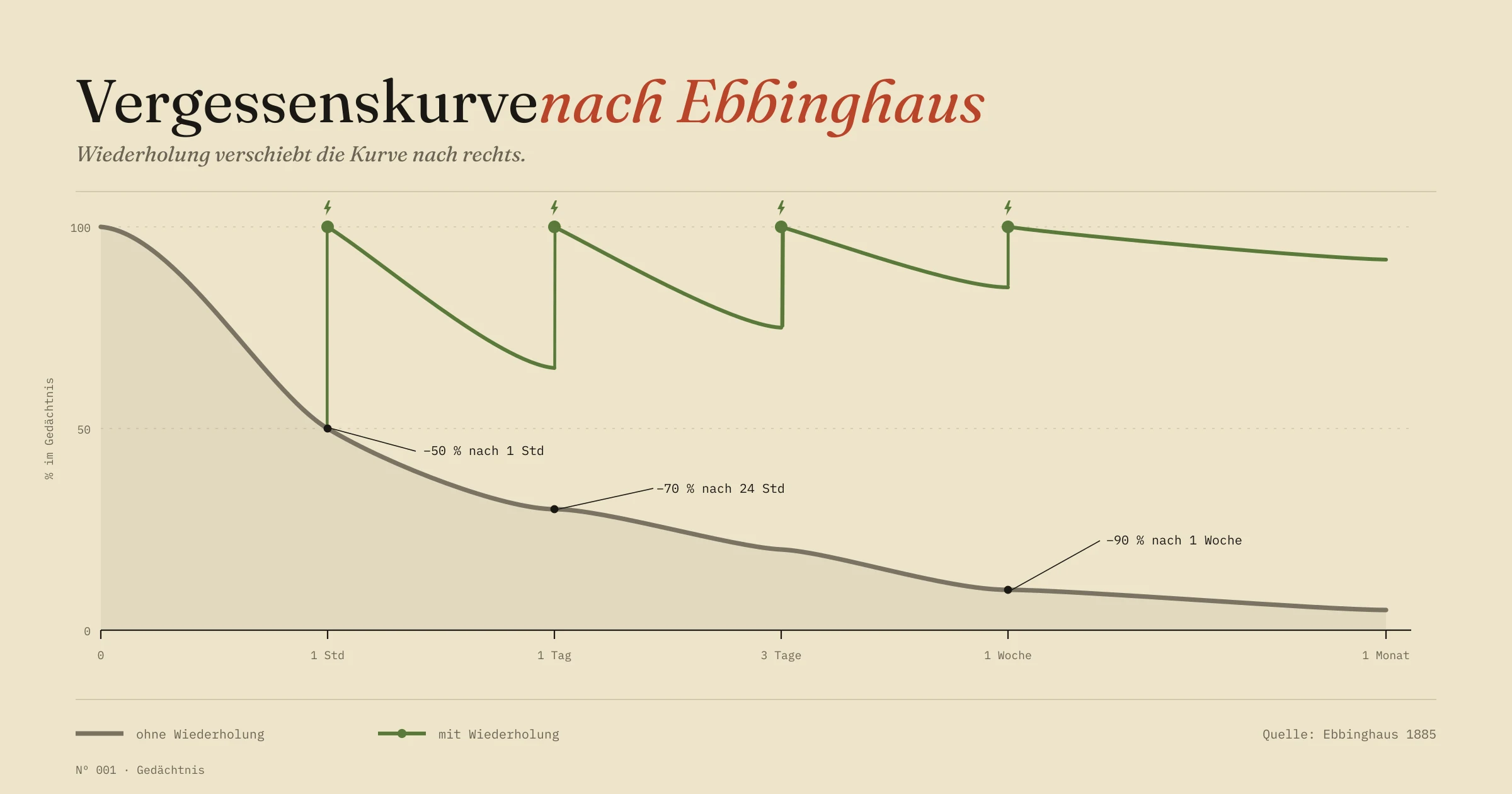
What happens to memory in the first day
When you see a new word for the first time the brain forms a weak neural connection. If it is not used, after a few hours the brain draws the perfectly reasonable conclusion: “If it has not been needed, it must not be important” — and the connection is weakened. That saves resources: if we held on to everything we saw in a day, our heads would overflow.
The problem is that the brain cannot tell the difference between things we genuinely don’t need and things we simply failed to repeat in time. For the brain, every inactive connection is a candidate for decay. That is exactly why Apfel, Schlüssel, Rechnung, which you learnt yesterday, slip away today: the connection was made but not consolidated.
Spaced repetition: how the defence works
The good news: every repetition strengthens the connection, and the subsequent forgetting unfolds more slowly. If you repeat a word exactly at the moment when you would otherwise have forgotten it, the effect is several times stronger than if you had read it through again straight away.
This is the spaced repetition effect, first described in the 1970s. The key conclusions:
- Too-frequent repetition wastes attention. The brain does not need reinforcement; the connection does not get stronger.
- Too-rare repetition means the word is already gone — you have to learn it from scratch. Progress drops to zero.
- Timely repetition, right before the word disappears, is the most powerful — comparable to a dozen repetitions in the wrong rhythm.
The job of a spaced-repetition algorithm (SRS — spaced repetition system) is to compute, for each word, exactly the moment when a repetition will have the biggest effect. That lets the system save your time: instead of going through all 2,000 words every day, you only work with the 50–100 that are currently “on the edge”.
What this looks like day-to-day
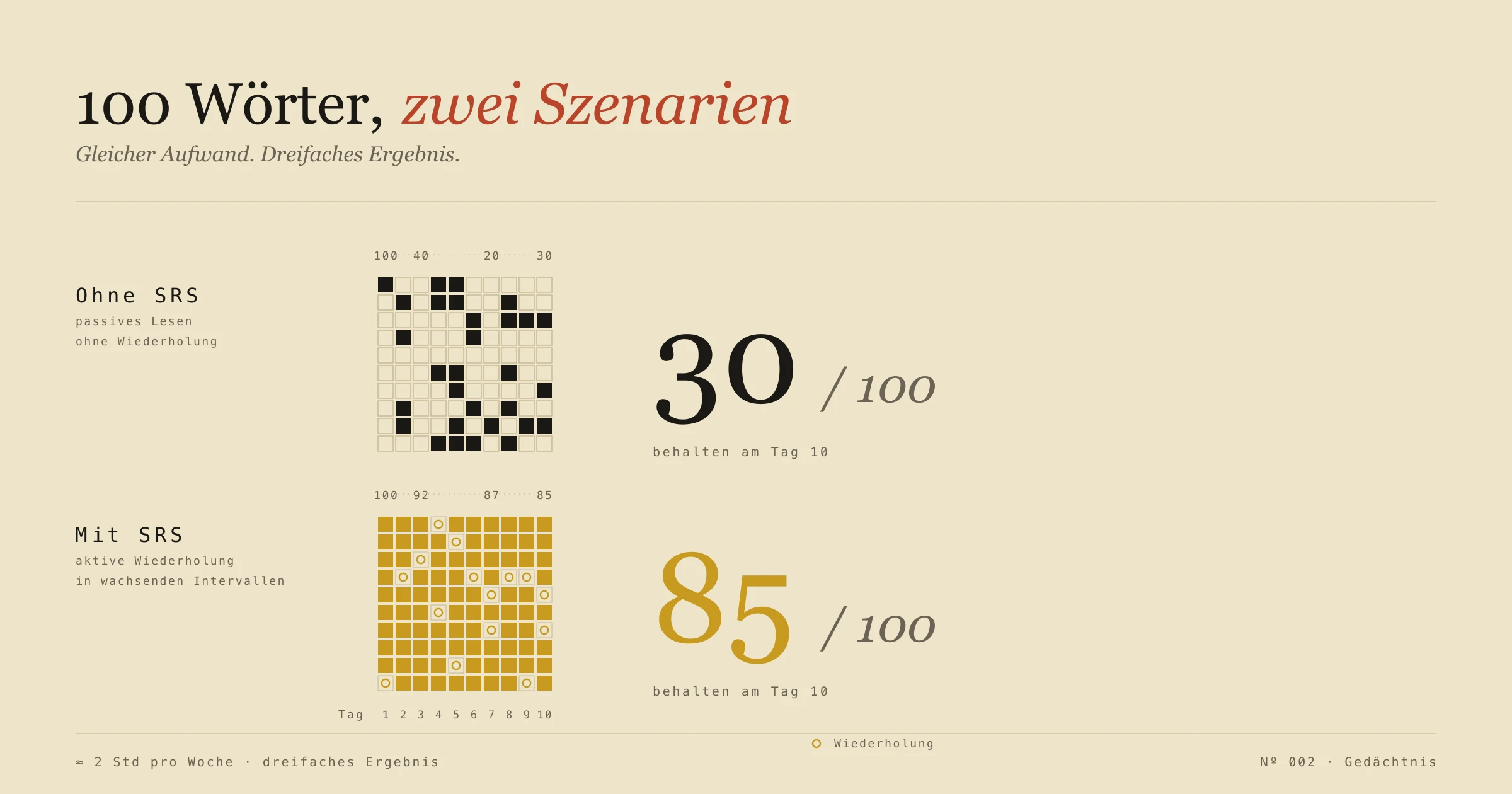
Scenario without SRS, 100 new words:
- Day 1 — 100 new words learnt.
- Day 2 — 40 of 100 remain.
- Day 3 — you repeat. 20 come back; 60 have to be re-learnt.
- Day 10 — at best 30 of 100 stick.
Scenario with SRS:
- Day 1 — 100 new words learnt.
- Day 2 — the algorithm shows you every word you have learnt; you have already forgotten half. You rate each one: “again”, “hard”, “good”, “easy”. The hard ones come back the next day; the easy ones in a few days.
- Day 3 — you see only the “hard” words plus a few new ones.
- Day 10 — 80–90 of 100 stick, and you keep them in growing intervals.
Both scenarios cost a couple of hours per week on average — but with the algorithm the retention rate is two to three times higher.
SRS algorithms: what works under the hood
The first widely used algorithm was SM-2, designed in 1987 by the Polish researcher Piotr Wozniak for SuperMemo. It is still the engine behind Anki, used by millions. SM-2 is relatively simple: every card has an “ease factor” by which the interval is multiplied after every grading. It works — but coarsely, because it does not account for the unevenness of forgetting.
The modern algorithm is FSRS (Free Spaced Repetition Scheduler), also by Wozniak, in its 2023 version. FSRS models the forgetting curve individually for each card: how many days it can hold before the target “recall probability” (usually 90%) is reached, and it sets the interval exactly to that point. That is 1.5–2× more precise than SM-2 in terms of unnecessary repetitions and spares the learner’s attention.
Artikle uses FSRS, tuned to the specifics of German: for nouns whose gender cannot be derived from the ending, intervals are shorter, because such words fade faster. Strong verbs get their own track, with more frequent reviews of the three principal parts (gehen — ging — gegangen).
Why this matters especially for German
In English an intermediate learner’s vocabulary is around 5,000 words — that volume can be kept fresh in a reasonable amount of time. For German you need 8,000–10,000 at B2, and more than 12,000 at C1. Without SRS this is physically impossible: there is simply not enough time to repeat.
On top of that come details that vanish on their own:
- The article — der, die or das. Drops out even when you know the word.
- The plural — ten different ending types with no reliable rule.
- The genitive of strong nouns (des Apfels, but des Jungen).
- Separable prefixes — aufstehen, but ich stehe auf.
The SRS algorithm has to track these details separately from the word itself. In Artikle a noun card checks the article; if you miss it, the word comes back into review even if you know the translation.
How much time this costs
Good news: spaced repetition is one of the most efficient learning methods in terms of “time / result”. A typical session in Artikle takes 5–15 minutes a day. That is enough to keep 2,000 active words in working memory and add 20–30 new ones per week.
Bad news: it requires regularity. SRS resets itself if you skip 10 days — reviews pile up, returning to the app becomes psychologically hard. That is why we deliberately keep the sessions short: 7 minutes a day beats 60 minutes on Saturday.
What to do with this today
If you are already learning German with Anki — you are on the right track. Anki works, but it requires you to make the cards yourself, find images and double-check articles. Most people drop out after a week.
If you are using Duolingo or Babbel — check whether there is a repetition mode. Spoiler: yes, but a weak one. Words are repeated based on the time since they were first learnt, not on your personal forgetting curve.
If you want a ready-made solution where cards, images, native pronunciation and FSRS play together — Artikle launches very soon. Join the waitlist and we will send you an invitation as soon as we open early access.